
The recent stimulus measures announced by China have seen most analysts sit up and take notice.
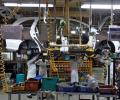
Auto majors Maruti Suzuki India and Hyundai reported muted sales performance in October as the companies curtailed dispatches to dealers in order to cut inventory build up.

The Reserve Bank of India's (RBI's) State of the Economy report for October acknowledged a slowdown in some high-frequency indicators but expressed confidence in a recovery, aided by consumption demand during the festival season. "In India, aggregate demand is poised to shrug off the temporary slowdown in momentum in the second quarter of 2024-25 as festival demand picks up pace and consumer confidence improves," said the report released on Monday.

India's steel market is out of step with global trends. Global demand is weak with China at a huge supply surplus to its domestic demand, pushing down global steel prices. India's domestic demand for steel is strong, given the continuing infrastructure push and is likely to accelerate as urbanisation improves, and the auto sector continues to grow alongside the infrastructure push.

The Tata Group is one of the very few Indian MNCs which has carved out a niche in China's highly competitive market, notes Rup Narayan Das.
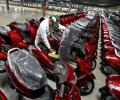
What has hit sentiment further is a draft proposal by the government to increase vehicle insurance premiums for financial year 2022-23 (FY23). Third-party motor insurance premiums have not been increased over the last two years and if this is approved, insurance costs for specific segments could rise by a fifth. The worst impacted is the 350cc and above two-wheeler segment, where premiums are up 21 per cent. Royal Enfield (Eicher Motor) is the market leader in the segment. The premiums in the 150-350cc two-wheeler category are also being inc

Closely watched by the world for any escalation, the Iran-Israel conflict is already showing early signs of stress for India Inc - longer deliveries, doubling freight rates, extended working capital cycles, and higher costs. For those yet to feel the heat, there is growing apprehension and nervousness over future developments, observed industry executives.

The S&P BSE Auto Index has been one of the biggest outperformers among sectoral indices over the past year with returns of 26 per cent. By comparison, the benchmarks - the National Stock Exchange Nifty50 and the S&P BSE Sensex - managed about 6-8 per cent during this period. Improving demand, falling raw material costs, and rising product realisations, led by the premiumisation of portfolios, have led to a revision of growth estimates and upgrades by domestic brokerages.

With sentiment for the automotive (auto) sector turning positive, stocks of two-wheeler auto majors have been hitting their 52-week highs. Hero MotoCorp, Bajaj Auto, TVS Motor Company, and Eicher Motors recently reached their yearly highs on strong sales in the festival season and the expectation of faster growth rates ahead. Since the start of this month, listed two-wheeler majors have delivered returns in the 12-17 per cent range, compared to the 7 per cent gains for the S&P BSE Auto Index and 3 per cent for the benchmark S&P BSE Sensex.
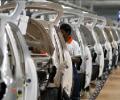
Amid a slowdown in the automotive industry, the Automotive Component Manufacturers Association of India asked the government to continue providing export incentives to domestic manufacturers, while expressing concern over India's growing number of free trade agreements.

koda Auto India is set to drive in a new car by the first half of next year to reach its target of 100,000 unit annual sales in the country by 2026. The compact sports utility vehicle (SUV) will be positioned against the likes of Maruti Brezza, Hyundai Venue, and Kia Sonet, and would be competitively priced, a senior company official said. koda will also export the car to right-hand-drive markets like Australia, New Zealand and the Asean nations.

Ford, which had announced to quit the Indian market last year, said it was exploring the possibility of using one of its plants in India to produce electric cars for exports.

Passenger vehicle sales are expected to experience muted growth in the current financial year.

Automotive (auto) major Mahindra & Mahindra (M&M), which is readying to launch nine sport utility vehicles (internal combustion engine/ICE), seven Born Electric Vehicles (BEVs), and seven light commercial vehicles by 2030, has outlined an investment of Rs 27,000 crore in its auto business between 2024-25 (FY25) and 2026-27 (FY27). Over the next three years, the company will deploy Rs 37,000 crore, including its auto business, farm business (Rs 5,000 crore), and service business (Rs 5,000 crore).

Maruti's results and the investor response indicate that quite a few stocks in the auto sector could be on the verge of a big bounce, says Devangshu Datta.

Despite the robust growth in this country, Apple's India share in its overall global sales remained modest -- constituting 1.5 per cent of its overall turnover of $389 billion in FY23.

The maker of Pulsar and Discover reported a net profit of Rs 1,138.20 crore in the second quarter, compared to Rs 1,402.42 crore a year ago.
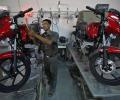
After selling brands like Pulsar, Boxer, Platina and RE in over 70 countries, Bajaj Auto plans to enter Thailand this year followed by Brazil next year.

India will not tailor its policies to suit US EV maker Tesla, and its laws and tariff rules will be formulated to attract all-electric vehicle manufacturers from across the world to set up a base in the world's fastest-growing economy, Commerce and Industry Minister Piyush Goyal said. Tesla has been seeking an initial tariff concession that would allow it to offset 70 per cent customs duty for cars priced less than $40,000, and 100 per cent for cars of higher value.
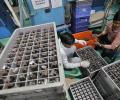
Auto component makers in India are bracing for a tough time. High absenteeism among workers owing to Covid-19, shortages of critical parts, and temporary closures of plants by automobile manufacturers have thrown a spanner in the works for the Rs 3.2-trillion sector, which derives 60 per cent of its revenues from automobile original equipment manufacturers (OEMs), with the balance split equally between replacement demand and exports. Car market leader Maruti Suzuki India on Saturday said it was extending the maintenance shutdown, which was from May 1 to 9, till May 16, "keeping in view the current pandemic situation". Some activities will continue in the plants.

Reflecting the woes of the Indian automobile industry, the country's car exports remained flat at 550,466 units in 2013-14, during which domestic sales fell for the second consecutive year.

It has been seven months since the iconic motorcycle manufacturers, Harley-Davidson and Triumph, embarked on their journey in India with the backing of partners Hero MotoCorp and Bajaj Auto. According to data shared by the Indian majors, both brands are already creating ripples in the above 350cc category. The increase in sales has prompted a ramp-up in production and even the doubling of retail touchpoints for one of them.


Whether it's Carrefour, Ford, or other foreign majors, they are ready to adjust their strategies and design their plans in a way that would address the Indian consumption story.

Automobile manufacturers, new and old, as well as ancillary suppliers are set to spend a combined Rs 70,630 crore over the next five years on either entering the electric vehicle segment or stepping up their presence in it. Data culled from announcements made by firms shows India, the world's fifth largest automobile market, is poised to receive one of the biggest capex pushes ever to fuel the transition from internal combustion engines to electric motors and batteries as part of a green drive. The EV push, egged on by the government's emphasis on electric mobility to meet its net zero targets, is expected to yield at least 25 electric vehicles - new ones as well as electrified versions of existing vehicles running on internal combustion engines.

The country's largest car maker Maruti Suzuki India on Friday reported a 47.8 per cent rise in net profit for the March quarter of FY24 to Rs 3,877.8 crore, on account of higher sales volume and favourable commodity prices.

The Budget proposals are expected to boost the fortunes of consumer goods and fast-moving consumer goods companies, which have been struggling with poor consumer demand for more than a year. The Budget announcements, such as the increase in standard deduction by Rs 25,000 for income-tax payers and slab revisions, will put more money in their hands, boosting consumer demand. Private consumption is also likely to benefit from a new scheme to offer internships to 10 million youths in the country's top 500 companies.

Prices may go up because of higher energy costs, caused by the rise in shipping charges, with commercial vessels taking a longer route to avoid the troubled Red Sea region, the finance ministry said on Monday. Iran-backed Houthi rebels of Yemen are repeatedly attacking ships in the Red Sea. While the global economy is grappling with challenges such as sticky inflation, sluggish growth, and mounting fiscal pressure, India's external sector could face "potential risks" due to the ongoing geopolitical tensions, according to the finance ministry's report on the review of the Indian economy.

There is another common trend among these three players - they are all registering a volume decline in a market that is expanding at over 8 per cent

Nepal's decision to ban the import of non-essential items amid depleting forex reserves may hit Indian exports. The country's central bank - Nepal Rastra Bank - last week instructed commercial banks not to open letters of credit (LCs) for importing non-essential items. This is to prevent further decline of the country's foreign exchange reserves. However, it has not issued any formal communication yet.

Indian auto manufacturers are well poised to become "winners" in terms of global market share in the next five years to join the ranks of established players like Hyundai, Toyota, Honda and Volkswagen.

Outbound shipments of engineering products in June to these nations doubled to $1.32 billion in June 2020, from $653.52 million in June 2019.

The stock of the country's largest passenger vehicle maker, Maruti Suzuki India (MSIL), has been hitting successive all-time highs over the past three trading sessions. The rally in the scrip has helped it notch over a 21 per cent gain since the start of February, outperforming the National Stock Exchange Nifty Auto Index. The gains for the leader of small passenger cars have been more recent, as the company still trails the Nifty Auto over one- and two-year periods.
The interim Budget in May this year had extended the depreciation benefit on purchase of new commercial vehicles to September from March 2009. Industry executives said this should be extended as sales of large vehicles slumped 40 per cent in April and May this year. Sales of medium and heavy commercial vehicles had dipped 33 per cent in 2008-2009.
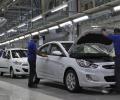
Passenger vehicle wholesales in India touched a record high of 42,18,746 units in the financial year 2023-24, registering a year-on-year growth of 8.4 per cent on the back of robust demand for utility vehicles, industry body SIAM said on Friday. As per the latest data issued by the Society of Indian Automobile Manufacturers (SIAM), the overall passenger vehicle dispatches stood at 38,90,114 units in fiscal year 2022-23. Two-wheeler sales were up 13.3 per cent last fiscal at 1,79,74,365 units, as compared to 1,58,62,771 units in the financial year 2022-23.

'In FY23, PV sales are expected to end the year at a record 3.8 million units, up 26 per cent. In FY24, however, the industry is expecting 5-7 per cent volume growth'

By the year 2026, India will be the third in the world after China and USA in engineering, manufacturing and export of vehicles and auto components.

The BSA Gold Star is launched....Ola Enters e-motorbikes Biz... Bajaj, TVS To Enter e2Ws Market...

Automobile dealers' body FADA said the Budget lacked immediate demand boosters for the automobile industry.

The budget has been neutral with positive bias for the auto component industry.
 © 2026 Rediff.com - Investor Information - Advertise with us - Disclaimer - Privacy Policy - Sitemap - Feedback - About us - Terms of use - Grievances